Tuesday, November 30, 2021

November 30 - Tempus Fugit - Where did Autumn Go?

 Tuesday, 11/30/2021 - It's 37 degrees with W winds 3 mph.  I've been non-stop working, but at a snail's pace.  I did go camping in October from the 17 - 21.  It was a pretty miserable experience with rain and high winds.  I had booked 2 half day trips at Hither Hills.  I lost $111 and did not go in early October as the weather and my exhaustion were not in best form.  Feeling buried in back-logged chores, I stayed home and worked the best I could inside and out.  


 I'm not sure I want to save a spot for next year in late August - early September because there is a split pole on the tent from gusting winds and not sure I have the energy to do this by myself, anymore.  Many years Ive spent solo camping because no one wants to camp with me. 

Today is November 30th and I have much work before me cleaning up the property, the organic veg garden, and cleaning the shed out, storing tools, and scraping/priming/painting window trim on south windows.  


the bare wood needs to be covered.  It's too cold now.  I may have blown the window of opportunity to finish this.

I'm on the 5th day of a Panceas cleanse and began another blog to cover the food plans.  

https://foodplanforgoodhealth.blogspot.com/

Hoping to get at least 10% of the exterior and interior work done before New Year's Day. 

                                     garden strays that withstand a chill
                      transplanted lettuce into this container for a winter salad
Carrots taste better after a frost

Dug up some newly re-seeded lettuce plants from the earlier lettuce plants.  Will be growing them indoors in December. 


Handful of carrots picked 11/27/2021


Thursday, September 9, 2021

 How can it be September 9?   Lindenhurst has had extreme weather patterns of heat waves. and torrential down pours, and high winds.  

All I can report off the top of my head is I had to mow down the veg garden in several different days due to the foxtail grass in seed, crabgrass, and every single weed known to mankind.  

Having missed out on many different garden activities due to chest pains, shortness of breath, and jaw/throat pain when exerting the slightest of effort pushing an electric lawn mower, raking, lifting, etc.  I've wasted enormous amounts of time getting the chores done.  And with all this work, the property still looks disheveled. 

Remembering the neighbor's elderberry shrubs, I stopped by and the man was outside.  He said I could come at anytime as long as the gate was open.  Closed meant his pit bulls were out.  That was last Saturday.   So yesterday, September 8th, I went there and luckily the gates were open.  With MORE rain coming, today, I knew yesterday was my only shot at cutting.   I settled for a brown shopping bag and left content with my offerings.  Their yard was filled with birds all gathering up little berries off the ground.  

I clipped off some nicely dense umbels filled with tiny berries ripened to perfection. 

As forecasted, it's raining, today, and I'm in bed resting to see if any chest pains are coming while the body remains calm, and no there are not. 

 I'm watching what I eat.  I made a stockpot of codfish chowder on Tuesday, September 7th.  

I used turnips from the veg garden.  3 lbs. of wild caught cod filets, clam juice, Maine seafood stock, and fat-free Half & Half.  This is a bowl cozy made by a friend, Bobbie, in Utah.  I just LOVE them.  I use them every day.  

                                             ~~~~~~~~~~~~~~~~~~~~


Back to the elderberries,  I need to boil them and remove the stems because there is cyanide in the plant.  The boiling destroys the chemical.  I need to do this today, but first things first.  I called my Cardiologist and made an appointment for October 1 to be seen.  Phew.  Yes this is a major priority.  

Easy does as easy goes.  Let the grass and weeds have their way.  I'll be paying for it next year with so many weed seeds dropping into the lovely organic rich soil of my gardens.  Seriously I put out to the curb and didn't compost between 3 - 6 giant cans a week of hand pulled invasive weeds to be collected by Sanitation - so how many billion seeds did I kick off the land?   This would have become a jungle.  And I'm not Tarzan's girl, Jane.  Though if I was 40 years younger I might love to swing on a vine with him. 


Sunday, August 1, 2021

So it's August 1 already.  Sunday morning.  Air is cool and a great day to get outdoor work done.  Weeds are out of control  10 foot wild lettuce going to seed is growing in asparagus ferns  

~~~~~~~~~~~~~~~~~~~~~~~~~~~~~~~~~~


The rain garden is beautiful.  The delicate looking Nigella is coming into bloom.   If you love the flower, Nigella, or Love in a Mist, and you are growing it, then you already have black cumin. Black cumin has been known as a medicinal plant for thousands of years, especially in the Orient. It is used as a spice and as an oil in many ways. Its beneficial properties are mentioned in the Bible and the prophet Mohammed is quoted as saying: “Black cumin cures every disease except death.” In Egypt it was called the gold of the pharaohs and Nefertiti is said to have rubbed herself with it regularly. The botanical name of black cumin is Nigella sativa, while the plant is popularly known under many names, like “kalonji” (from Hindi), “Roman coriander”, or in Germany “Catherine’s flower”, due to its wheel-shaped flowers. In Europe, it was first cultivated during the Middle Ages as a medicinal plant by monks in their monastery gardens. Packed With Antioxidants. May Lower Cholesterol. Could Have Cancer-Fighting Properties. Can Help Kill off Bacteria.

May Alleviate Inflammation. Could Help Protect the Liver. Can Aid in Blood Sugar Regulation. May Prevent Stomach Ulcers. Crack the seeds like you would black pepper and use as a seasoning.


My new Primary Care doctor is suggesting a STATIN drug. Heck no. My bloodwork shows an increase in cholesterol. I just ordered black cumin seed and will use it in a pepper mill - 1/4 teaspoon a day to flavor foods and lower the #'s.

Thursday, July 29, 2021

 July 29 2021 -  I've been so busy fostering baby starlings that were just released on July 25th, that I forgot to make July entries here.  

                                       June 23 2021.  2 nestling starlings. 


                                                 July 15 2021 - fledglings

Being so distracted with fostering the birds, the property has sadly returned to weed heaven with a record amount of rainfall this July egging the weeds on.  I've been working slowly on the driveway project and sorely neglected the organic veg garden and the re-painting of the 1929 kitchen.  Why didn't I drop more cardboard down over the insidious weeds germinating faster than lightening?  This morning, I filled a bucket with a plethora of promiscuous weeds that germinated wildly, and I picked a handful of green beans amongst the many weeds turning into seed heads this week.  I have to rip out as many as possible, but another storm is coming today.  And I'm scheduled for a hair cut - first one since 2019. 

Still in physical therapy, my  body has slowed down, and on those mornings when I feel no pain, but am very tired upon awakening,  I love to rest in bed, and listen to the birds. There are so many wonderful bird species living on my property. I could stay in bed for hours with the dual aspect windows wide open and listen to them. I especially love the increase in number of Northern Cardinals who have found the Borage flowers growing wild in the organic veg garden very appealing. They may being eating the flower and the seed.

                                            Cardinal nest and eggs.  
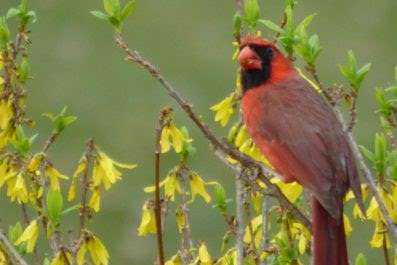
Cardinals eat the seeds of the forsythia shrubs in late Spring .  This is what the seed looks like. 

Bright red male Northern Cardinal.

Bright red with a pointed head crest and black bib, male cardinals are always a welcome sight here. Cardinals prefer thick underbrush for nesting. Cardinals have been expanding their range northward from the south for many years.

Both male and female cardinals sing almost year-round. Common calls include "cheer cheer cheer", "whit-chew whit-chew whit-chew" and "purty purty purty". Cardinals eat seeds, fruit, and insects, and are easily attracted to bird feeders, especially those containing sunflower seeds.

Male cardinals defend their territory. Females usually sing after males establish territory but just before nesting starts. A cardinal's nest consists of a tightly woven cup of roots, stems and twigs lined with fine grass and hair.

I've been seeing many young fledgling cardinals everywhere on the property.  And this brings me back to the veg garden and the wild, overgrown self-sown return of the Borage plants.  Bees are everywhere.  And the cardinals are competing for some of those tasty flowers and seeds. 

I started growing Borage in the mid 1980's. And decorated a lot of cakes, and English Trifles with their flowers. Borage has limited culinary use in today’s foods, but the borage flower is often used as a garnish. I crystalize them for cake decorations. Borage was used to treat many ailments, from jaundice to kidney problems. In medicinal use today it is limited, but the seeds are a source of linolenic acid. Borage flowers are also used in potpourris or candied for use in confections. Their cucumber-flavored leaves are used for tea and other beverages as well as bright, starry blue flowers for decorating salads. All parts of the plant, except the roots, are edible.


Borage, orange day lilies, and asparagus ferns. Rear of the organic vegetable garden in mid-July.  Is it any wonder that the bees and butterflies birds love this peaceful, pristine garden?  

Saturday, June 26, 2021

 June 26 - Summer has arrived.  We had a beautiful Full Strawberry Moon on June 24th.  Summer memories always revolve around nature's aromas and scents.  One plant that you wouldn't think contributes to a flowery essence is the common privet hedge - Ligustrum ovalifolium. When you study & memorize the phenology of a garden, if you ever became deaf & blind, you'd always know when the seasons come and go by the fragrance in the garden. You'd learn that Spring is over when the wild roses stop blossoming, and that summer is here when the wild privets are in full blossom. The fragrance of these small, seemingly insignificant flowers is a trademark of summers on Long Island. If you take the time to sit in nature by the untrimmed, wild privets growing in your yard like I do, memories of childhood summers most surely will flood your thoughts. A great shrub to attract bees. The entire yard is intoxicatingly fragrant, today. I am remembering my adolescence living on Jackson Ave. in Lindenhurst, and walking along Copiague Road toward Zahns Airport in Lindenhurst and smelling these flowers that filled the air with summer's perfume. And while walking from the small airport, I searched the ground for yellow buttercups to hold underneath my brother's chin to test whether he liked butter. Ahhh the memories of a childhood out in nature. Priceless!


Sunday, June 13, 2021

Triodanis Biflora - June in the organic Gardens.

 It's a delightful cool Sunday morning - 62 degrees and no wind.  A perfect day to burn these piles of wood.  While I tend to 2 burning pits and use the chain saw and pruners to make smaller pieces to burn, I can clean up and trim, rake and tidy up the north organic gardens.   There's a special plant I've been observing and want to share info on it, this morning.   It's Native to America and so sweet and clean cut, upright, and interesting to look at.  

Today I saw the very first dark purple flowers open up.  But only on the top of the plant.  I love it's cupped leaves.  It's got a strong stem and is upright, but still small and dainty. 


Blooms in various stages of development.   Today there are the first purple blooms coming out and they are on the top of the slender plant. 

Triodanis perfoliata
 is native to the United States and Canada. This species grows in all of the lower states in the United States except Nevada; it also grows in British Columbia, Ontario, and Quebec.


Tridanis biflora
 is also native to the United States but only grows in the lower U. S. from Oregon and California through Arizona and New Mexico. It also grows in states south of and including Nebraska, Missouri, Illinois, Kentucky and Virginia as well as in New York State and Pennsylvania.

Monday, June 7, 2021

 A sunny hot Monday, June 7, 80 degrees and very humid.  I observed many many yellow flowers on tall firm stems.   Yellow Hawkweed.  It's growing in clusters so no fescue grass can grow.   I need to dig them out.  

Hieracium caespitosum

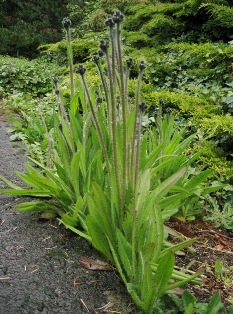
Yellow hawkweed in bud (Hieracium caespitosum) - click for larger image

Yellow hawkweed has clusters of many small, yellow dandelion-like flower heads on top of mostly leafless stems. The erect, bristly stems can grow up to 3 feet tall, each topped by 5 to 30 bright yellow flower heads in a compact, flat-topped cluster. Each plant produces 10 to 30 flower stems. Flowers in bud are distinctively rounded and black-hairy in tight clusters at the tops of the stems.

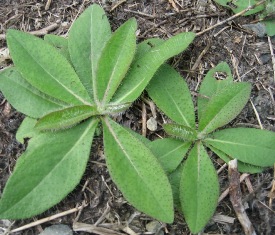
The leaves are long and narrow, up to six inches long, not lobed, somewhat hairy on both sides, and form a basal rosette. There are also usually one or two small leaves on the stem. The entire plant contains a milky juice. Yellow hawkweed has a shallow root system and underground creeping stems called rhizomes. New plants can arise from buds on the rhizomes and plants can develop several creeping stems (like strawberries) that are also capable of producing new plants.

Yellow hawkweed rosettes (Hieracium caespitosum) - click for larger image

Yellow hawkweed is a perennial and spreads by seeds, stolons and rhizomes. It flowers from mid-May to July and usually sets seed by August. Yellow hawkweed thrives in disturbed areas such as roadsides, gravel pits and pastures. It can also invade meadows and forested areas and is well-adapted to life at higher elevations. Usually found in sunny areas, it is somewhat shade tolerant.

Hawkweed identification can be difficult and often requires technical details such as hair types. Also, hybridization between species can make it even more confusing. 

Hibernating During the Dreary Days of February of 2025

 All the major holidays have passed offering relief and reprieve from all expectations or disappointments.  Weather is a winter of chilly da...