Saturday, May 25, 2024

Eastern Tiger Swallowtails are the first of the season in late May on Long Island, NY .

 I foolishly did some necessary chores bringing winter things into the attic and 3 trips made me short of breath. But I did get outside to work on clearing out the cut down invasive daylilies that are taking over the north edge of the asparagus and veg garden - even the old compost pile. I dragged one tall can to the front for pick up next week. Anything invasive I don't add to an anerobic pile. I had to sit before even going inside and up the 4 stoop steps.


As I sat, I was gifted with seeing my very first yellow eastern tiger swallowtail flying into the understory of Sassafras I allowed to grow next to the 100 year old maples. They love butterfly bush (Buddleia), Joe-Pye Weed (Eutrochium purpureum), milkweed (Asclepias spp.), phlox (Phlox spp.), ironweed (Vernonia spp.), and lilac (Syringa spp.).

I don't believe in any of this hokey pokey, I believe in the science and data. But it amused me to read: Yellow butterflies symbolize positivity, hope, and transformation. Seeing one might mean good news or big, positive changes are headed your way. Spiritually, a yellow butterfly can symbolize that you're near a spiritual awakening. It might also be a sign that your passed loved ones are thinking of you.

I could use a little hope & positivity these days.

🙂

Wednesday, May 15, 2024

Mid May is time for the property to slowly transition from Early Spring Color then soften to White flowers as the ferocious weeds get ready to overtake.

  May 15, 2024 - a rainy day! 60 degrees. 93% humidity SE winds 8 mph. When we reach mid May, all the early Spring colors are fading or have already faded. Daffodils and tulips are gone. Yellow Forsythias are gone. So are the apricot colored flowering Quince.

Now in the wild hedgerow the Spirea is in full blossom but sadly entwined in invasive Japanese honeysuckle. What an impossible job pulling it out.


Beach plum is in full flower. I've envied the sand dunes along Long Island for having these lovely plants for years, and feeling like a trespasser going there in August to spy on their fruit development and hoping to pinch a few fruits. Now I have my very own that I got from the NYSDEC's Saratoga Nursery.

And Lily of the Valley - a quiet little ground cover that comes and goes quickly but leaves their intoxicating fragrance in your mind, forever.

The white Dogwood lights up the entire north property and speaks of my Father's gardening skills as he grew this from a graft taken on N Broadway at his friend Amy Keller's house. She was his art student.


And everywhere you look are tiny clumps of white Star of Bethlehem determined to divide and conquer the garden beds and seek haven in every nook and cranny.


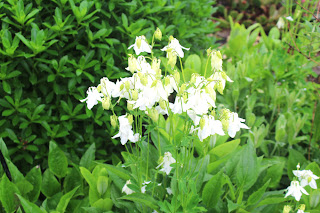
And let's not forget White Columbine, sure to return every Spring in mid May with glorious bright white nodding flowers.


I've always loved having a white garden because I feel a white flower has much more fragrance than any other. And with sunsets at 8:05 PM tonight, the white flowers just light up every path they find a home to call their own.

Saturday, May 20, 2023

May 20th and the Rain are coming down after a drought

 I never finished mowing the north side of the property and seemingly overnight the perennial weeds, and woody vines of invasive weeds have shot up in record time. The grasses will be too high for one mow over them. This is when I find myself walking outside and do nothing more than pull & pull, snip and clip woody vines, hand pull cleavers in flower, rip out honeysuckle, pokeweed, nightshade, mugwort, tall grasses, bindweed, but always forgetting to cut Asiatic bitterseet then brush on a few drops of  Triclopyr, Triethylamine Salt with an artist paintbrush making sure not to spill any on the ground.  Then there's Virginia creeper on the fences, and English Ivy, errrrr. 

Yes Mid May is WEED SEASON.  It always escapes me. And it's the neverending job of chasing it as t always wins in the end. The overwintering chickweed has gone to seed and I'm sure that whatever I rake up is dropping a bazillion seeds. 

 Galinsoga is all over the open garden area even though it was covered all winter.  At least its easy to remove. The dandelions have pretty much shot their load of white balls of seeds on parasols. I tried my best to collect the seed heads. 

Welcome to my nightmare!   Organic gardeners can all relate!!!  

Yellow Sorrel


Wild Lettuce can grow up to 10 feet. 

Ribwort Plantain

Purple dead nettle


Red Dead Nettle 

Japanese Knotweed

Invasive honeysuckle

Himalayan Blackberry - very invasive


Pilosella known as mouse-ear hawkweed

Henbit

Hairy Bittercress


Galinsoga

Annual Winter chickweed

Asiatic Bittersweet 


Garlic Mustard


Oh and there are MANY more lurking underground for June, July, August. I feel old just lying in bed watching the rains pour down on the property, and preparing the next set of weeds to germinate. 
~


Saturday, March 25, 2023

Allergy Season in March? Could it be that Silver Maple Tree in my yard?

 Acer saccharinum

One of the most common trees you may encounter near water is known as Silver Maple. Readily identifiable in Summer by it’s leaf color in which the upper side is green while the underside is a ‘sliver’ or gray color. This feature makes for a beautiful site on a breezy summer day.


Clusters of small flowers will form in early Spring, February to May depending on location, and are roughly 1/8”-1/4” diameter.  Flowers are green/yellow in color.  Trees can be either gender, or have both (dioecious) and even change it’s gender over time.

Flowers are primarily wind pollinated, although some bees do visit.  But not long after pollination of female flowers seeds will begin to form.  Seeds are encapsulated within a ‘wing’ that spins as it falls to the ground.  Two wings are attached together to form a pair.


Self-seeding

Mature Silver Maples will drop thousands of seeds each Spring.  These will readily germinate if they are kept moist.  So, any flower bed with moist soil will likely have new trees each Summer.  They are easy to deal with in that they are not deeply rooted, but there could be many of them depending on conditions.  

The purpose of samara fruits, as with all fruits, is to disperse seeds. The plant reproduces by making seeds, but those seeds need to find their way into the ground so they can grow. Seed dispersal is a big part of flowering plant reproduction. Samaras do this by spinning to the ground, sometimes catching the wind and traveling farther. This is ideal for the plant because it helps it spread and cover more territory with new plants.


Silver Maple leaves are opposite (paired) along branches.  Leaves are up to 6” long by 4” wide, with deeply divided lobes with serrated margins.  Often there are secondary lobes contained within the primary.  Leaves have fairly long stems (petioles) that are 3-5” long.  In Autumn the leaves will turn a yellow color.

Tuesday, March 21, 2023

Seaside Goldenrod - a late summer nectar & pollen bearing tubular disk flowers

 A fellow Long Island gardener from Port Washington sent me 4 types of seeds in an envelope that she harvested off her native garden plants. The 1st of the 4 just germinated from sowings I started indoors on March 9th. - 12 days ago. Seaside Goldenrod - Solidago sempervirens

There are many different types. Perennial goldenrod is tolerant of standing water, drought, and saline soils.The flower head has tubular disk flowers in the center and ray flowers, these often strap-shaped, around the periphery. The numerous small flowers of goldenrods are filled with nectar. Those many small flowers are filled with pollen, too. This means the late summer flowers attract a wide variety of nectar-sipping, pollen-eating bees, beetles, butterflies, moths, flies, and wasps. The seaside goldenrod found along Eastern Shores of Long Island provide refueling stations for monarch butterflies during fall migration. Mine has non invasive rhizomes, but spreads many seeds. It's native to eastern America. https://www.gardenia.net/compare.../solidago_--_goldenrods

Sunday, March 19, 2023

Mason Bee Cocoons brought home yesterday, Saturday, March 18 2023

 Mason bees are powerhouse pollinators, visiting many flowers in a short amount of time and carrying enormous amounts of pollen on their bodies. Studies have shown that 250 to 300 mason bees can do the equivalent work of 90,000 honey bees (Apis). Bees in the genus Osmia fashion their nests in preexisting holes and cavities – some natural, such as hollow plant stems, while other times they rely on cracks and crevices in stone and brick (masonry) walls. At least one species, Osmia bicolor, constructs its brood cells in abandoned snail shells! Mason bees mark the entrances to their nests with a scent that is unique to them.


Say hello to a Mason Bee. Mason bees in the genus Osmia are a diverse group of solitary bees known for their important role in pollination. With over 300 species worldwide Osmia bees are distributed across all continents except Antarctica. There are over 100 species of mason bees in North America! They are commonly found in a variety of habitats ranging from deserts to forests. As cavity nesters, Osmia construct their nests using natural or manufactured cavities such as hollow plant stems, insect tunnels, or drilled wood blocks. Due to their efficient pollination abilities and ease of management, these bees have become increasingly popular as an alternative to honey bees in agriculture and horticulture. Mason bees are so-called for their habit of using mud to construct their nests, and for their habit of nesting in cracks and crevices of crumbling mortar in walls.

to bee continued.


Hibernating During the Dreary Days of February of 2025

 All the major holidays have passed offering relief and reprieve from all expectations or disappointments.  Weather is a winter of chilly da...